
Helping Students Say, “I Can Do This”
October 05, 2026
LSU College of Science alumna JoAnna Stewart reflects on the experiences that shaped her as a science educator and the lessons she hopes her students carry beyond the classroom.
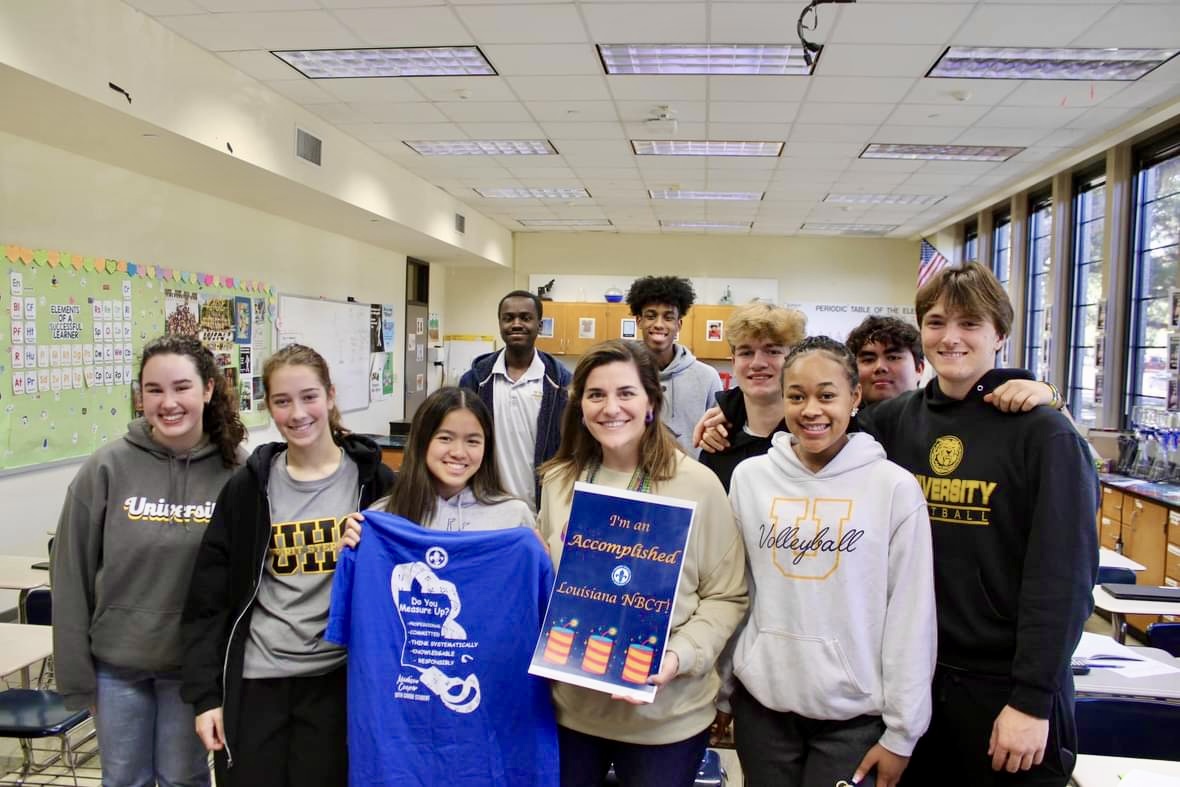
Stewart celebrates with her Dual Enrollment Chemistry II class after earning National Board Certification in chemistry teaching.
For JoAnna Stewart, teaching science is about more than helping students master the material. It’s about helping them build confidence, think critically, and discover they can tackle questions that once seemed intimidating.
An LSU alumna and longtime science educator, Stewart graduated from LSU in 2011 with a bachelor’s degree in Biological Sciences and a teaching certification through LSU’s GeauxTeach STEM program. The program gave her the opportunity to step into a classroom before graduating, where working with mentor teacher Mr. Dyer and his students helped her realize that teaching was where she wanted to be.
She later returned to LSU through the Louisiana Math and Science Teacher Institute (LA-MSTI), earning a Master of Natural Sciences with concentrations in Chemistry and Biology. For her thesis, she studied how different cooperative learning structures affected high school chemistry students’ learning, research that continues to influence her approach to student collaboration in her own classroom.
Today, Stewart teaches 10th, 11th, and 12th graders in Chemistry and Dual Enrollment Chemistry II at LSU Laboratory School. For World Teachers’ Day, we asked her about the experiences that shaped her as an educator, what she loves about teaching science, and what she hopes her students take with them beyond the classroom.
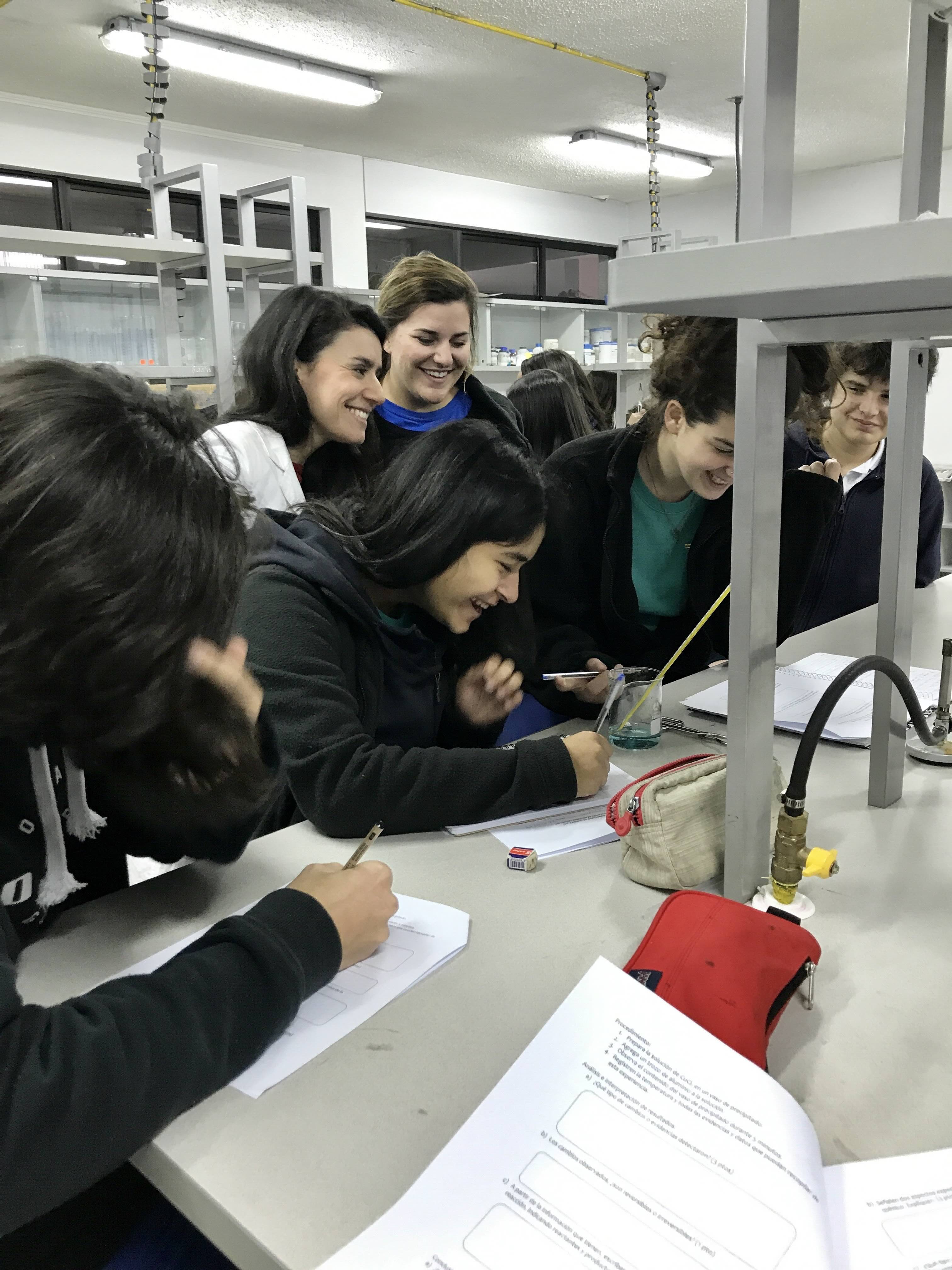
A summer teaching in Chile gave Stewart the chance to experience science education from a new perspective through an international program offered by LSU.
What has helped you grow most as an educator?
GeauxTeach was one of the experiences that shaped me early on, especially the personal connections I made with my classmates, mentors, and students.
Gaining real classroom experience while I was still in college was incredibly valuable, but so was having a group of people who understood what I was experiencing and could empathize with the challenges of learning to teach.
We could bounce ideas off each other, share what was working, and get creative together. Those relationships helped shape not only the teacher I was becoming, but also the way I approach collaboration with other educators today.
I also owe a great deal to LSU Laboratory School for the teacher I am today. The school has afforded me opportunities that are difficult to find elsewhere in the state, from professional development and teaching abroad to traveling internationally with students to present scientific research. The administration encourages teachers to share their knowledge through student-teacher mentorship and conference presentations while also encouraging us to continue learning through professional development.
I am also fortunate to work with colleagues who help me grow, challenge my thinking, and collaborate with me to make our science department dynamic.
What do you enjoy most about teaching science to young people, and what are some of the challenges?
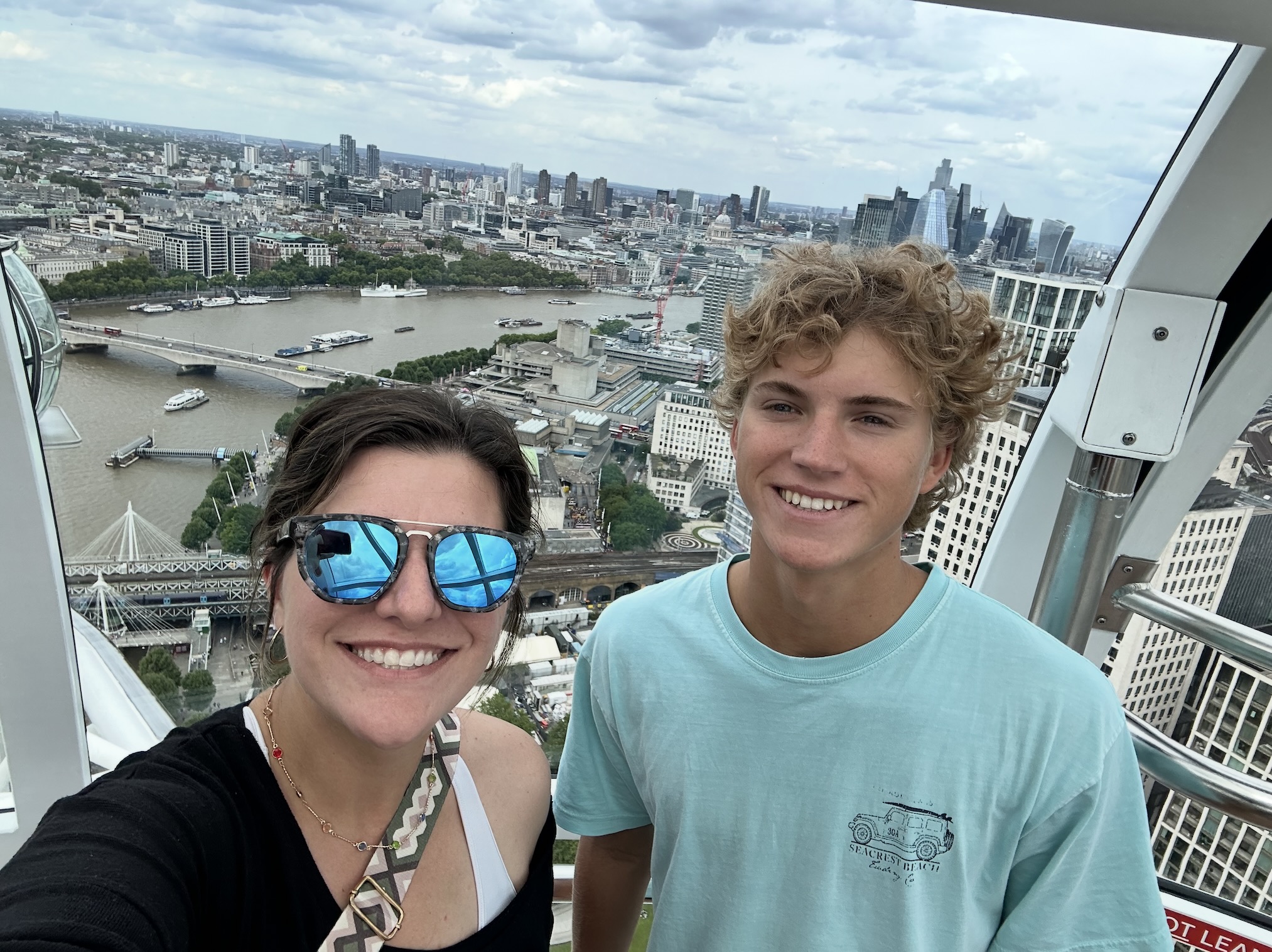
A proud teaching moment: joining her student Adam in London as he presented his research on drone use after natural disasters.
What I enjoy most about teaching science is watching students gain confidence. Chemistry can be intimidating and challenging, so I love seeing the moment when a student begins to understand a concept and realizes, “I can do this.”
I especially love when we move from something that exists on paper to something students can actually see happening in front of them. After a laboratory experiment, I love reading students’ explanations of a phenomenon and seeing them make connections between the chemistry and the real world.
One of the biggest challenges I face is finding the balance between students who are ready to take the material much further and those who are still building the foundational skills they need. Finding ways to challenge students who are mastering the material while also helping students who are struggling rise to the challenge is something I work on every day.
It’s one of the reasons I continue to seek out best practices and reflect on what I can do differently to reach every student. It is also one reason I returned to LSU as a student once more to pursue a Certificate of Education Specialist in Science Education.
What are you most proud of in your teaching career so far?
I think I am most proud of the number of opportunities I have helped create to expose students to science beyond the traditional classroom. Whether it is helping with our school’s annual Halloween Science Day, earning Tree Campus certification, creating hands-on experiences in our Discovery Lab, participating in LSU’s Super Science Saturday, or giving students the opportunity to study abroad through the London International Youth Science Forum, I love creating experiences that allow students to see science in a new way.
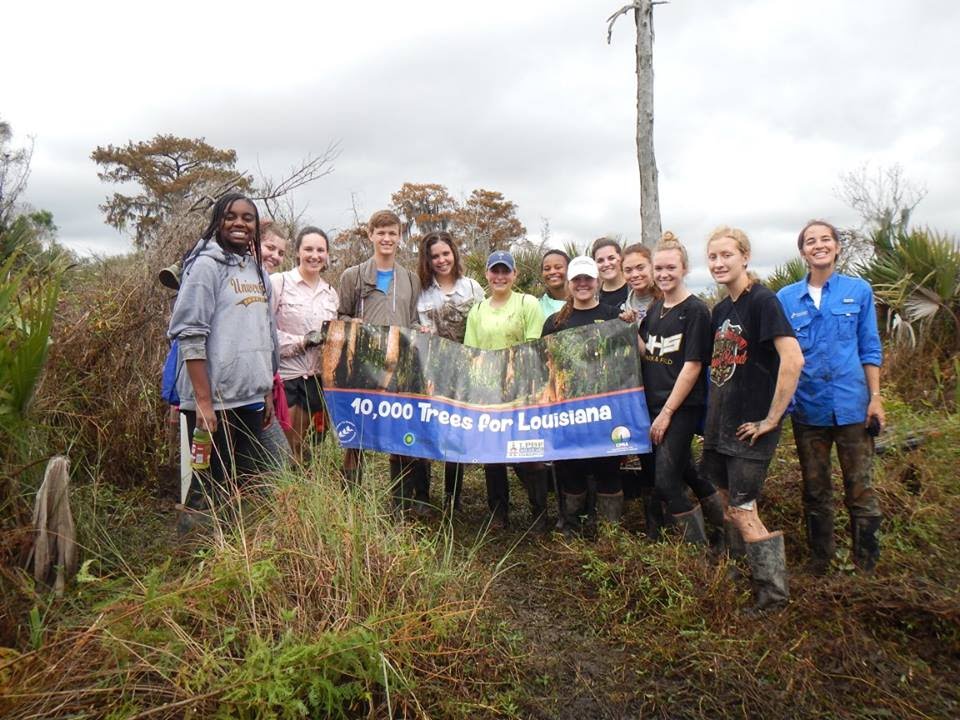
Taking science beyond the classroom, Stewart’s students put learning into action by planting trees with the Coalition to Restore Coastal Louisiana.
I want my students to understand that science is not simply something they learn for a test, but something they can experience, explore, question, and be a part of.
Teaching has also given me the opportunity to continue learning alongside my students. My career has taken me places and provided experiences I never could have imagined when I first became a teacher. I have traveled across the country for conferences, participated in fieldwork along the coast, taught science in Chile, and traveled to London with students. Those experiences have reminded me that learning does not have to stop when you leave the classroom.
In many ways, teaching has allowed me to keep experiencing science while helping my students discover all the ways it can be a part of their own lives.
How has being a parent shaped your perspective as a teacher?
Becoming a parent has definitely changed my perspective as a teacher. I think I am more empathetic toward students and more aware of the fact that every child who walks into my classroom is someone’s child.
I obviously want my own children to have the best education possible, so I sometimes find myself reflecting after a lesson and asking, “Would I be happy if my own children were being taught this way?” That question pushes me to continually evaluate my teaching.
I also want my children to be critical thinkers and problem-solvers, and that has reinforced how important it is for me to create opportunities for those skills in my classroom.
What are some of your favorite memories from your time as a student at LSU?
Some of my favorite memories from LSU as an undergraduate were the quintessential LSU experiences: tailgates, football games, and those late nights in the library before a big exam.
When I returned as a graduate student, I had a completely different appreciation for LSU. I was able to see the campus, facilities, and resources through the eyes of a teacher and scientist, and I realized just how special it was to have that kind of environment as part of my professional journey.
Looking back, LSU has been part of nearly every stage of my journey as an educator, from becoming a teacher to continuing my education to creating opportunities for my own students.
What do you wish more people understood about being a teacher?
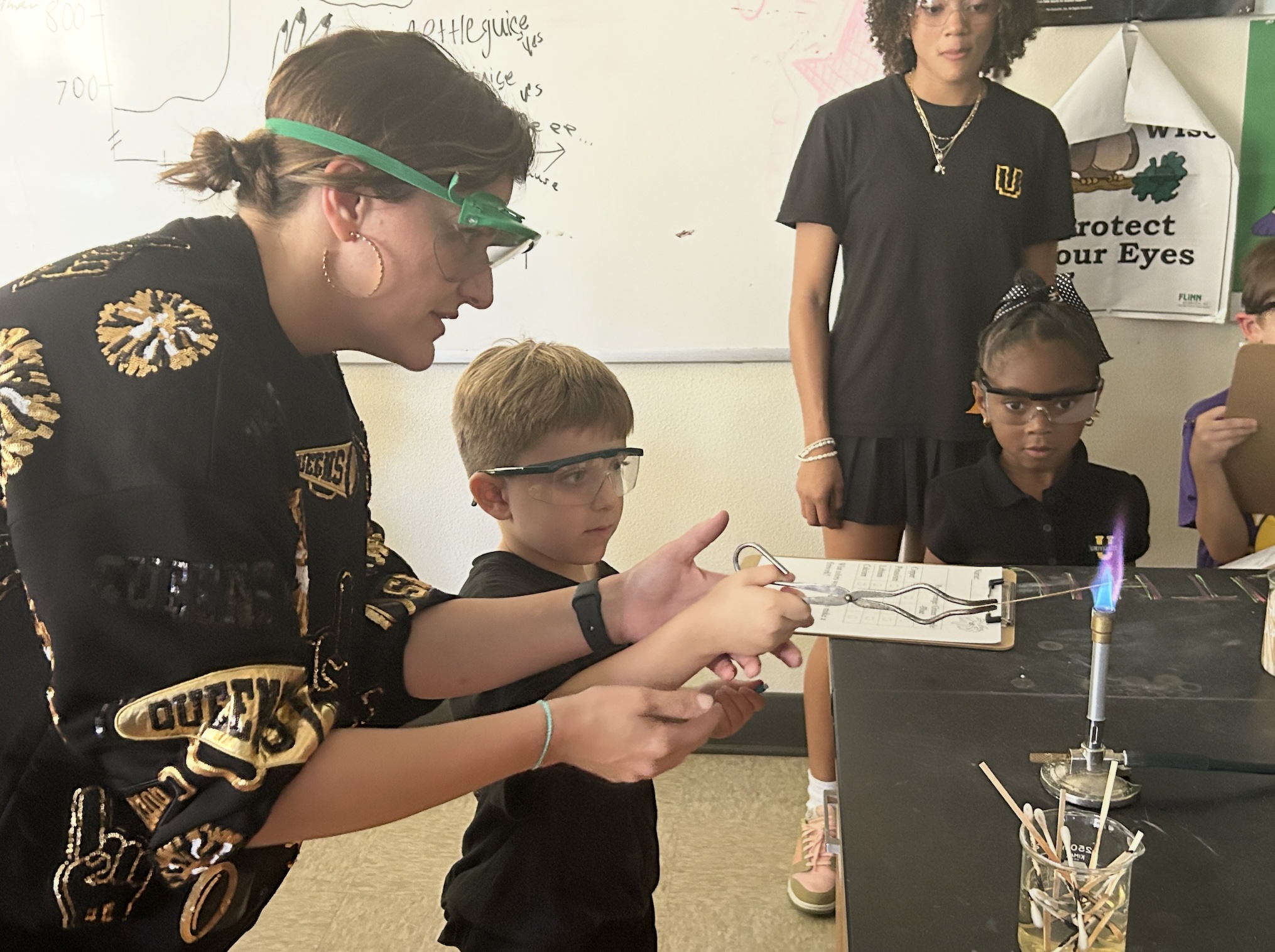
Stewart leads a flame test demonstration with elementary students visiting her chemistry classroom for a hands-on lab experience.
I wish more people understood how constant the work is. Summer break is well-deserved and needed! Teachers spend countless hours outside of their scheduled school day grading, planning, reflecting, communicating with families, chaperoning dances, doing morning and afternoon duties, attending sporting events to support students, and going to plays and other activities.
My brain is almost always reflecting on the day: What worked? What didn’t? Which student needs more support? What could I do differently tomorrow?
Teaching doesn’t really end when the students are dismissed. We carry our students and our classrooms with us long after the school day is over. Despite the challenges and the work that happens behind the scenes, I cannot imagine doing anything else.
Finally, what’s your favorite chemistry demonstration to share with students?
It is hard to choose just one favorite chemistry demonstration, but the crowd-pleasers are always fun! Some of my favorites are exploding pumpkins, methane bubbles, and flame tests.
When students can experience the chemistry happening in front of them, it becomes much more meaningful. That is what teaching science is ultimately about: helping students become curious, confident, and excited to understand the world around them.