
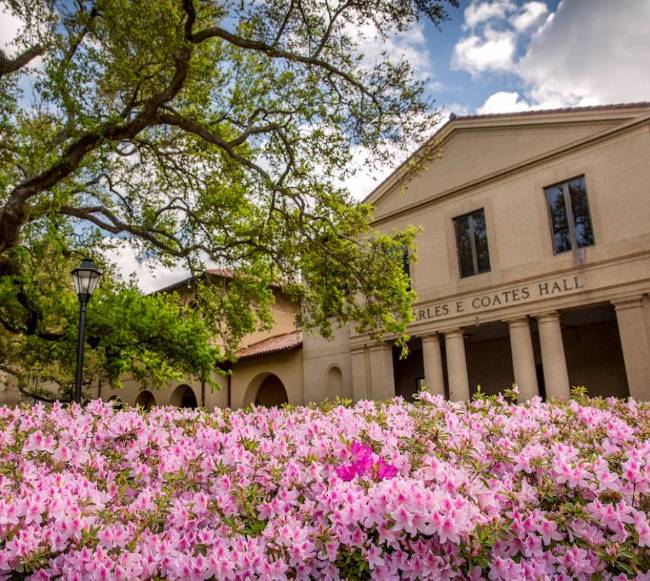


LSU Names Clint Willson Associate Vice Chancellor of Water and Coast
August 19, 2026
River engineer will lead one of two research portfolios built around the energy and water nexus while continuing to serve as dean of the LSU College of the Coast & Environment.
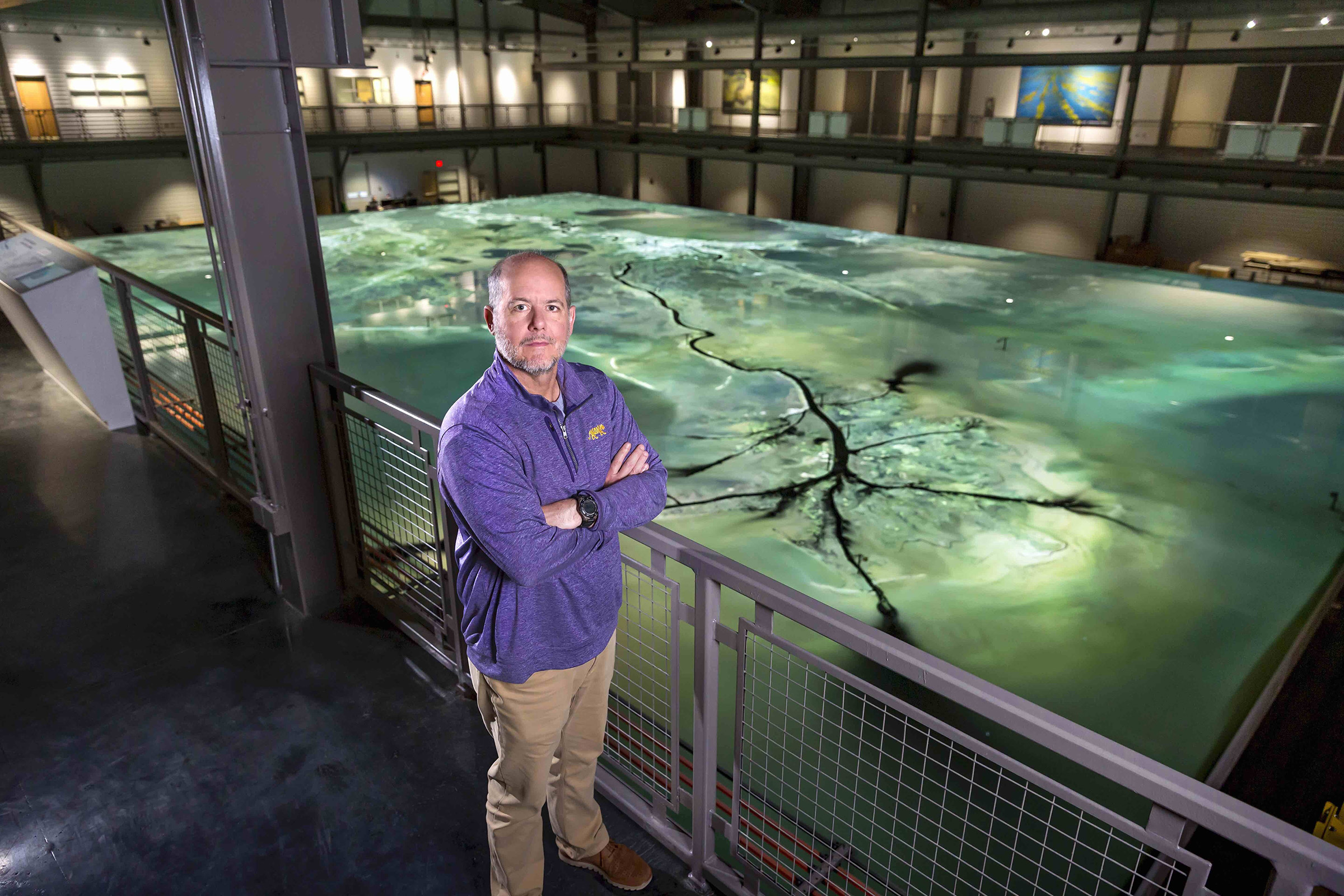
Clint Willson stands by the Lower Mississippi River Physical Model in the LSU Center for River Studies.
LSU’s Office of Research & Economic Development (ORED) has named Clint Willson associate vice chancellor of water and coast, a new position to help guide the university’s interdisciplinary river, coastal, and water research.
In this role, Willson, who serves as dean of the LSU College of the Coast & Environment and is the founding director of the LSU Center for River Studies, will report to Vice Chancellor Robert Twilley. He will support and help align LSU’s College of the Coast & Environment, Center for River Studies, Coastal Ecosystem Design Studio, Coastal Studies Institute, and Louisiana Sea Grant—five units with overlapping expertise.
The appointment completes a two-part structure ORED is building around what Twilley calls the energy and water nexus: the recognition that two of Louisiana’s defining research challenges are inseparable in practice.
ORED has spent the past two years consolidating energy research and service to the state under the LSU Energy Institute while anchoring the National Science Foundation-funded FUEL engine and increasing the university’s collaboration with U.S. Department of Energy national laboratories, including Idaho National Lab, Argonne National Lab, and Oak Ridge National Lab. Water, rivers, and coast provide critical context for much of this work.
“You can’t understand energy in this state without understanding water, and you can’t understand water without understanding the industry built on it.”
Robert Twilley, Vice Chancellor of Research and Economic Development
“Our selection of Willson, a water resources engineer, to help lead discussions on some of Louisiana’s most pressing problems is part of our core mission and service to the state,” Twilley said.
Three Decades on the River
Willson, a licensed professional engineer, has been at LSU since 1998. He was named dean in 2024 and held an endowed professorship in civil and environmental engineering. He is a fellow of the Coastal Studies Institute, chairs the executive committee of the Coastal Ecosystem Design Studio, and sits on the Louisiana Sea Grant advisory council. He was recently named chair of the American Society of Civil Engineers’ Coasts, Oceans, Ports and Rivers Institute waterways committee and to the National Geographic Society and Chubb Charitable Foundation Blue Boundaries program science committee.
Willson’s research centers on physical and numerical modeling of Mississippi River hydrodynamics and sediment transport. His early work at LSU focused on non-destructive porous-media imaging with applications to fluid flow and transport, and groundwater modeling of the Chicot Aquifer in southwest Louisiana. The best-known product of that work sits on the Baton Rouge Water Campus: the 10,000-square-foot Lower Mississippi River Physical Model, which reproduces 190 miles of river from Donaldsonville to the Gulf and compresses a year of water and sediment movement into an hour of lab time. Engineers use it to see how natural processes and man-made alterations to the river and its infrastructure impact how sand moves down the river.
Supporting the Energy and Water Nexus
Louisiana produces a steady supply of questions related to energy and the coast. Refineries, chemical plants, and LNG terminals cluster along the lower Mississippi because deep water provides access to them, and the same sediment engineers want to use for coastal restoration projects to nourish sinking marshes must not jeopardize critical navigation channels. Meanwhile, carbon dioxide bound for geologic storage will be injected beneath coastal parishes that are themselves losing land; low-carbon hydrogen consumes water at scale; and thousands of miles of pipeline sit in open water that used to be wetland.
Willson’s expertise will help ORED support research to more effectively address water resources, sediment budgets, land-loss projections, and coastal design.
“The questions that come to us from agencies, industry, and communities down the bayou or along the river don’t arrive sorted by discipline,” Willson said. “Our answers must come from a combination of experts who know whether a channel will silt in, whether a marsh will hold, or whether an intake will go salty. It often takes a modeler, a sedimentologist, a wetland scientist, a designer, and a Sea Grant agent who knows the parish and the people to provide the best answers, and we have all of them at LSU. My job is to bring them together.”
The convergence of coast and energy supports LSU’s mission and federal designation as a land-grant (under the 1862 Morrill Act), sea-grant (LSU became the nation’s 13th Sea Grant College in 1978), and space-grant institution. Only about a dozen universities nationwide hold the triple designation, including Cornell, MIT, NC State, Oregon State, Penn State, Purdue, and LSU. Each designation carries an obligation to move research out of the lab and into the world. At LSU, this means agricultural extension through the LSU AgCenter, coastal outreach through Louisiana Sea Grant agents in fishing and port communities, and Louisiana Space Grant Consortium research, development, and training of a future generation of experts to work in satellite observation and other areas NASA and the state care about.