


As NASA’s Artemis Goals Face Supply Challenges, LSU Research Explores Moon-Based Materials
May 11, 2026
If humans are going to live and work on the moon, they can’t bring everything with them. Every pound of cargo launched from Earth adds enormous cost and complexity, making long-term lunar missions difficult to sustain.
The challenge isn’t just getting to the moon—it’s learning how to stay there.
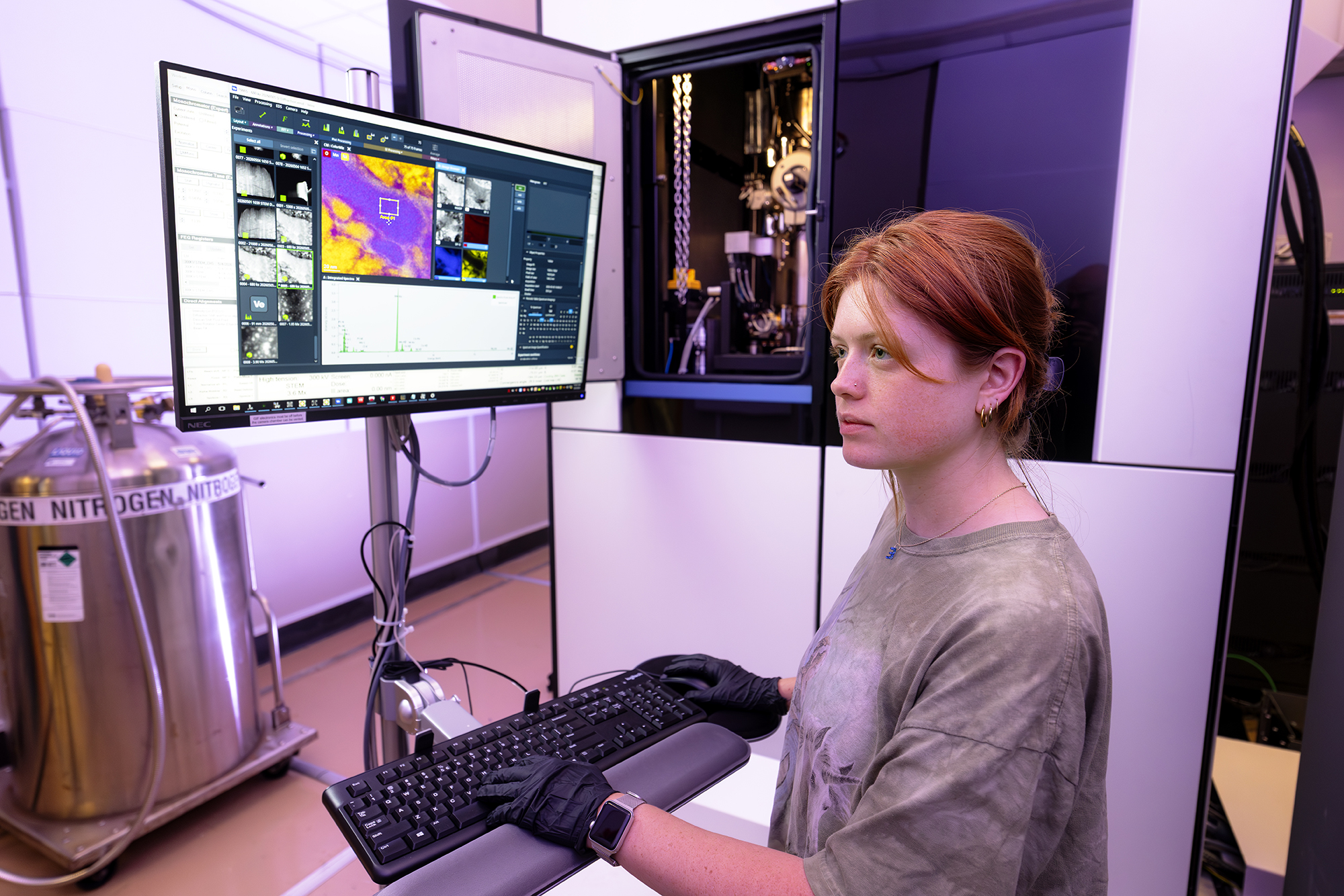
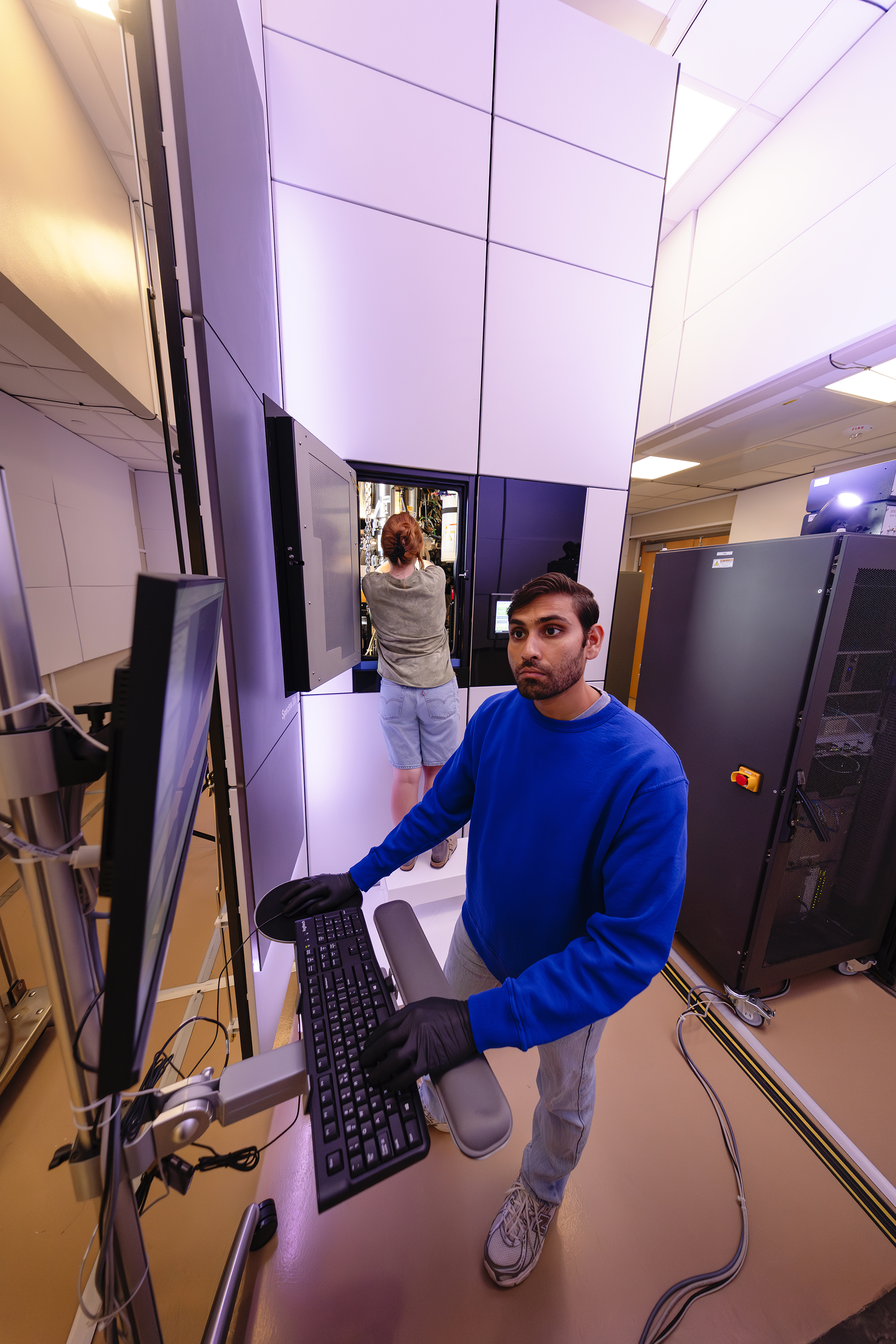
Emma McCarthy examines results on a computer near LSU's Spectra 300 Scanning Transmission Electron Microscope.
At LSU, mechanical engineering researchers are tackling that challenge by rethinking one of the most basic needs of any settlement: materials. Instead of shipping metals and building supplies across space, they’re asking a question: What if we could make what we need using moon dust?
In LSU’s Extreme Processing & Interfacial Complexions (EPIC) Lab, overseen by Christopher Marvel, first-year PhD student Emma McCarthy is exploring how lunar regolith—the fine, powdery soil that covers the moon—could be transformed into usable metals and energy.
With support from NASA-funded programs, the work represents an early but promising step toward building a sustainable human presence beyond Earth.


You Can’t Pack a Moon Base
Building anything on the moon comes with a fundamental constraint: limited resources.
“I would say there’s a challenge because we want to limit the amount of supplies that we need to bring from Earth,” McCarthy said. “We want to make it as efficient as we can.”
Transporting construction materials from Earth is not only expensive—it’s impractical for long-term missions like NASA’s Artemis program, which aims to establish a sustained human presence on the lunar surface.
The solution lies in what NASA calls in-situ resource utilization (ISRU)—using materials already available on the moon.
“We want to figure out a way where we can easily extract and use the materials that are already present on the moon,” McCarthy said. “That's the main goal.”
Turning Moon Dust into Metal and Energy
McCarthy’s research focuses on chemical processes called thermite reactions, which produce intense heat and separate metals from their oxides. It involves mixing powdered forms of a metal fuel and a metal oxide—often aluminum and iron oxide.
“It's called an oxidation-reduction process,” she said. “As you heat the system up, the oxygen actually prefers to leave the iron and go to the aluminum, and the process of the aluminum bonding with the oxygen gives off a ton of energy.”
And, importantly, pure metal.
On Earth, thermite is commonly used to weld railroad tracks. On the moon, it could serve a dual purpose: generating extreme energy and heat for repairs while also producing usable metals like aluminum and iron.
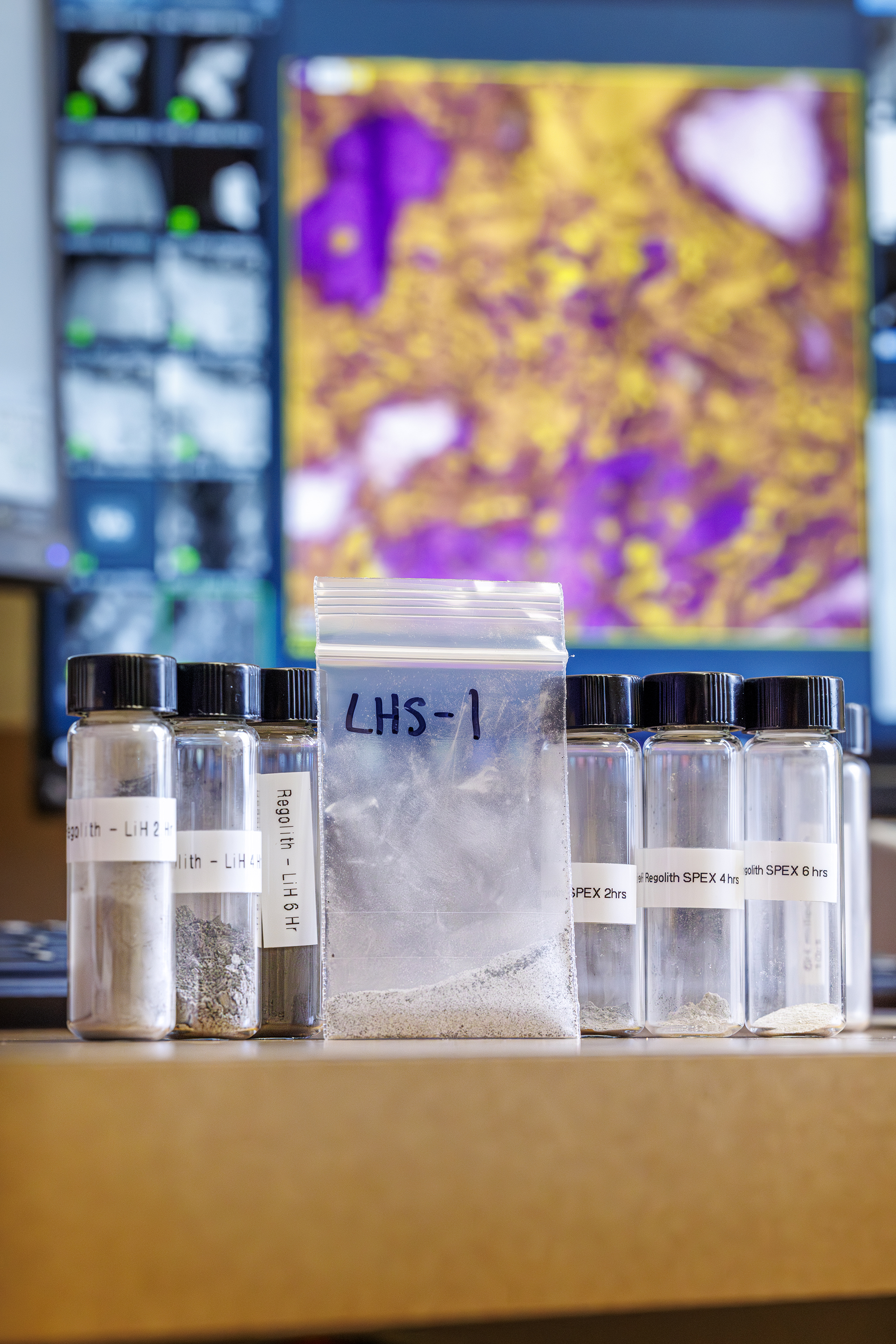
The LSU team is taking this concept a step further by adapting it to lunar conditions. Instead of traditional materials, they use simulated lunar regolith—rich in metal oxides—and pair it with lithium hydride, a highly reactive compound.
The result is a reaction that could simultaneously produce construction materials and energy.
Simulating Space on Earth
McCarthy, a Louisiana native, works under the guidance of Marvel, assistant professor in LSU’s Department of Mechanical and Industrial Engineering, and with the assistance of Octavio Combellas-Jaimes, a freshman in mechanical engineering, who was born in Houston and attended high school in Mandeville, La.
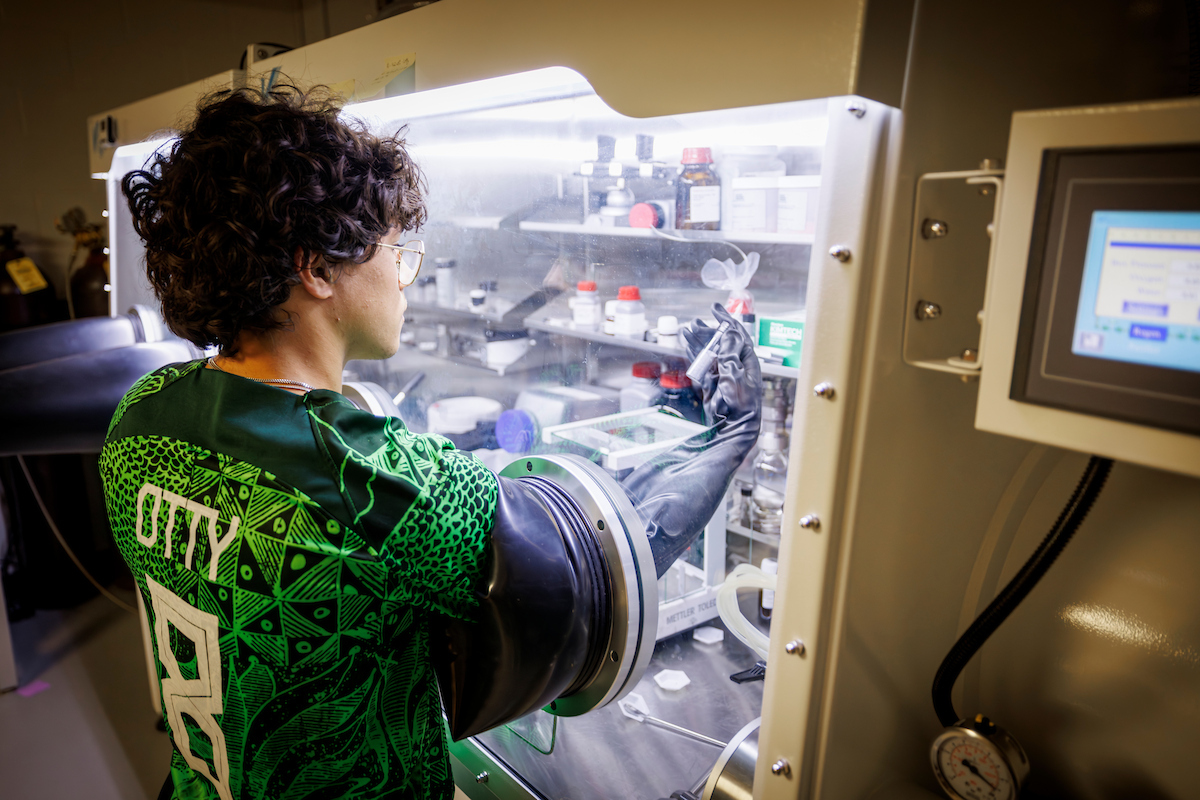
Octavio Combellas-Jaimes works in LSU’s Extreme Processing & Interfacial Complexions (EPIC) Lab.
Combellas-Jaimes’ role has included using cryogenic ball mills to process regolith into fine powders for the team’s experiments and polishing the resulting metals for inspection with advanced electron microscopy.
To test their ideas, the team recreates lunar conditions inside the lab, using an argon glove box so the materials are only exposed to an environment similar to space.
“We pack everything up in the ball mills inside the argon glove box so that it stays in that kind of environment while we're ball milling it as well,” McCarthy said.
“We're seeing what it would look like as if it were ball milled in space, which is super important because it might—especially the lithium being in an oxygen-rich environment—it might behave very differently than in an argon-rich environment.”
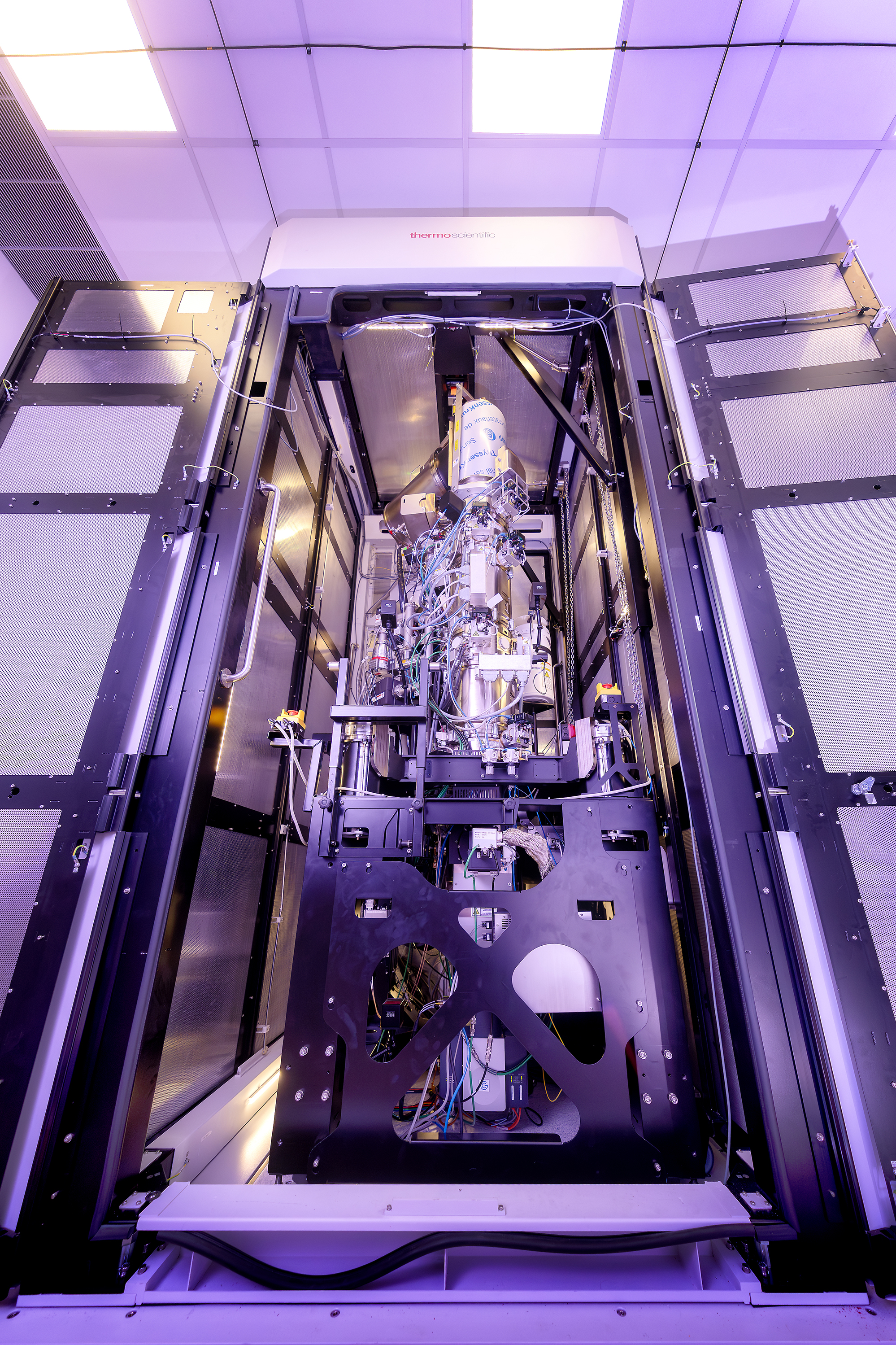
Electron microscopes allow the researchers to study materials at the atomic level to learn about their strengths and weaknesses.
“We want to see how well we’re mixing the material and what kind of structure it produces,” she said. “That microstructure can influence whether the reaction will actually work.”
Graduate and undergraduate researchers play a key role in this process. Combellas-Jaimes spends hours preparing materials and learning advanced techniques.
“My goal has been to pick up as many skills as I can,” he said. “Every day I’m learning something new that contributes to solving this problem.”
Building and Sustaining Life Beyond Earth
While the research is still in its early stages, the implications are far-reaching.
Marvel sees the work not just as a way to build structures, but as a versatile tool for sustaining life on the moon. Beyond construction, the process could also produce heat and even hydrogen fuel—maximizing every resource extracted from lunar soil.
“If you get metals out of it, great. If you generate heat and recycle that, great. If you get hydrogen, that works too,” Marvel said. “I think it would be a pretty versatile capability.”
For students like Combellas-Jaimes, the work is as inspiring as it is practical.
“I can actually apply what I’m learning here to something that might happen in real life,” he said. “That kind of blew my mind.”
And for McCarthy, the motivation is clear: helping humanity take its next step into space.
“The big picture is creating sustainable, efficient ways to use local resources for space exploration,” she said.