



A Study of Copepod Gene Expression Shows Flexibility Is Key to Coping with a Changing Climate
May 20, 2026
Isabelle Neylan cracks the lid on a container that might have once held wonton soup as she talks about her research in a lab on the fourth floor of the new Interdisciplinary Science Building on LSU’s main campus.
“If you want to take a peek, they are about a millimeter long and visible to the naked eye,” Neylan said, pointing to where hundreds of tiny creatures dart through green-tinted water. “That green fuzz at the bottom is the algae they like to eat.”
These tiny creatures belong to a group of organisms called copepods, small aquatic crustaceans related to crabs and shrimp. Copepods account for the bulk of the ocean’s biomass. They are also a good organism to study to understand how other organisms, marine ecosystems, and food webs might fare in the future.

According to Isabelle Neylan, copepods are found along the entire Pacific coast, from Alaska to Mexico.
Neylan is an NSF postdoctoral research fellow at LSU, where she works with Morgan Kelly and Brant Faircloth in the LSU College of Science’s Department of Biological Sciences. She has been studying a copepod called Tigriopus californicus and its genetic adaptation and evolution in response to climate change.
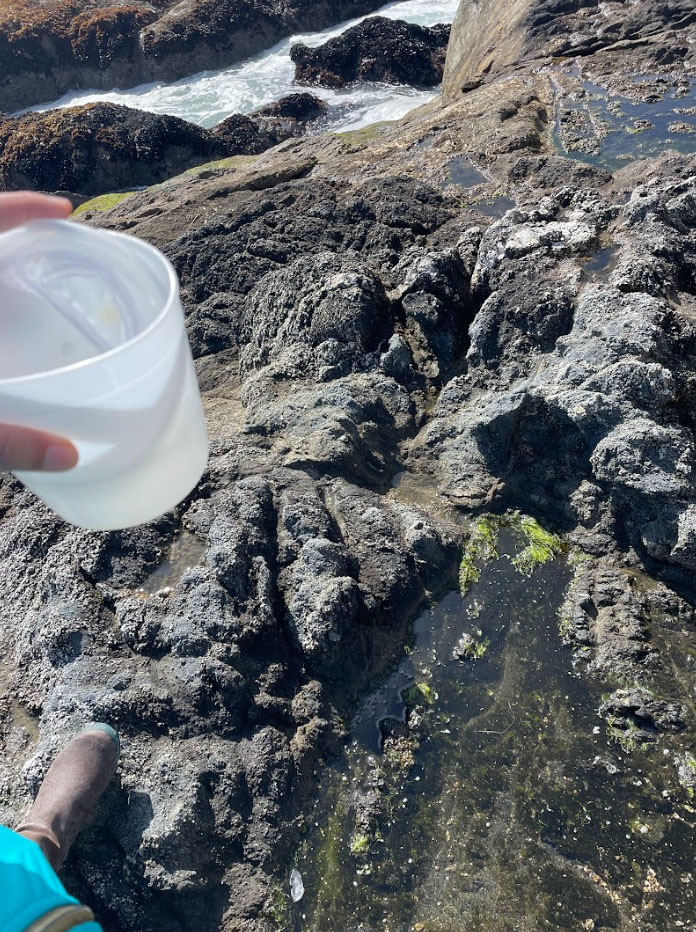
Isabelle Neylan, seen collecting samples, said the copepod's natural habitat is rocky intertidal pools.
“We love working with this organism because its natural habitat is rocky intertidal pools, basically shallow puddles that often sit and bake in the sun,” Neylan said. “This leads to sharp variations in temperature in a short amount of time.”
These copepods are also found along the entire Pacific coast, from Alaska to Mexico. “These guys are really good at handling temperature fluctuations,” Neylan said. “But we want to understand how they do it, and if their adaptive capabilities vary across populations.”
In a study just published in the Royal Society Proceedings B, Neylan compared copepod individuals from two populations in California, one northern and one southern. Intriguingly, the results are more promising for northern populations of these tiny creatures.
Northern populations seem to have a greater built-in ability to flexibly adjust their expression of heat shock proteins and other protective mechanisms in response to environmental stressors. Southern populations share some of this flexibility, but they are quickly approaching a ceiling of how much temperature variation they can handle.
Plasticity and Evolution
When organisms encounter new environmental conditions, whether by moving into new habitats or as their existing habitats change, they often fare better if they can adapt quickly. This adaptation can be genetic, in which the underlying DNA blueprint changes due to genetic mutations. Some genetic mutations end up enhancing survival, leading to genetic evolution. But a single genome can also produce different phenotypes, or observable characteristics and traits, in response to the environment. This is known as phenotypic plasticity.
“Evolutionary changes that lead to reduced plasticity can increase vulnerability to changing environments.”
— Isabelle Neylan
Plasticity works because genes aren’t always expressed into RNA and ultimately proteins; gene expression can be turned on or off or ramped up or down in response to environmental conditions. Some genetically encoded traits are naturally more plastic, with greater variability in gene expression under different conditions.
The good thing about phenotypic plasticity is that it acts as a buffer, allowing organisms to survive rapid changes. But new research shows it could also be key to facilitating genetic evolution, or adaptation at the level of DNA blueprints.
How this shakes out may seem counterintuitive. For example, some copepods living in warm southern climates have genetically evolved to become more heat-tolerant. This would seem like a positive thing in a world affected by climate change, with average temperatures rising.
The problem is that climate change doesn’t just involve overall warming; it also involves more chaotic weather patterns and extreme conditions.
“We know climate change is very real; it’s not just getting warmer slowly, but also becoming more variable with more heat waves,” Neylan said. “We want to understand how copepods, for example, might respond in the future to more variability.”
There are two ways copepods can adapt to heat waves. They can adapt so that genes for dealing with heat are permanently baked into their DNA, a process called genetic assimilation. Alternatively, they can adapt to have genetically encoded traits that are highly plastic, meaning they evolve to deal with extremes, called genetic accommodation.
This is what Neylan has been exploring in Tigriopus californicus copepods: Which way have they adapted to heat stressors, through genetic assimilation or accommodation? And what does that mean for their ability to continue adapting in the future?
Differing Levels of Adaptive Potential
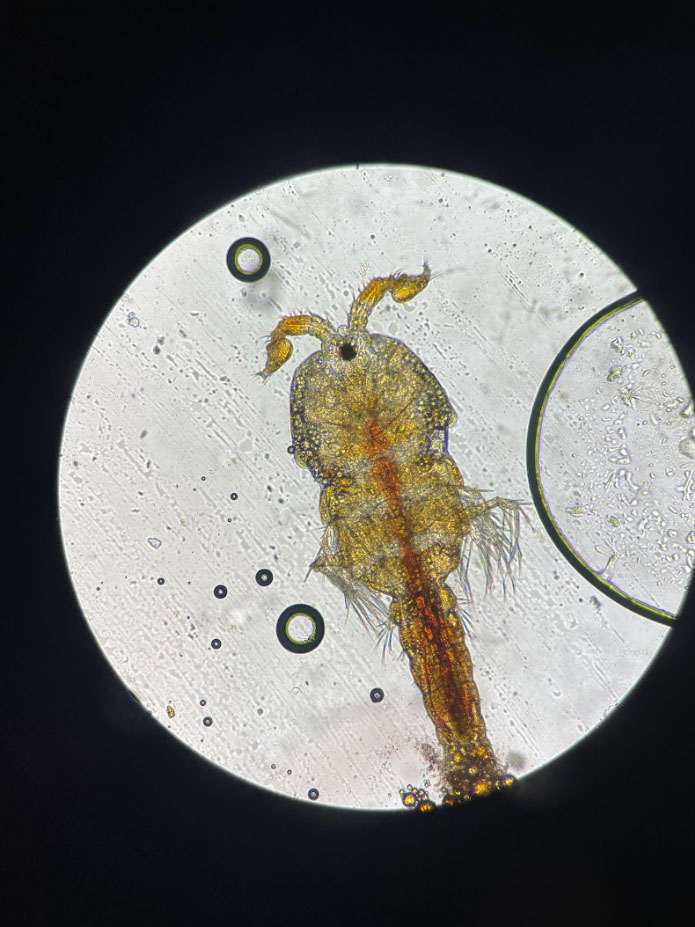
A copepod seen under magnification
Neylan analyzed the RNA of northern and southern copepod populations under control conditions and after exposing them to heat shocks as adults, as larvae, or both. RNA is the messenger molecule created from DNA; it often holds instructions for making proteins.
When copepods are exposed to heat stress, they produce heat shock proteins, which protect sensitive cellular components from "melting" out of shape. But Neylan found that in the northern California population, the expression of these heat shock proteins was significantly higher if the copepods had prior experience with heat stress, particularly as larvae. Early-life heat stress makes them more plastic later in life, able to produce heat shock proteins more quickly in response to future heat stress.
Also, the same genes that Neylan found to be plastic in response to heat shocks in the northern population appeared to underlie the evolving thermal tolerance in the southern population, suggesting some genetic accommodation.
But while some of these genes, such as heat shock proteins, remain plastic in the southern population, others are becoming more stable, with higher baseline expression regardless of heat stress. This suggests lower plasticity in these traits, or more “baked-in” genetics, which may make the southern copepod population less flexible in response to future environmental changes.
“The northern population is more thermally sensitive, but they are also able to adjust their physiology better,” Neylan said. “So if you give them a sub-lethal heat shock, they are better able to adjust and cope, versus in the south, where they are more tolerant but have less room for adjustment.”
What does this mean for the southern copepod population’s ability to adapt to climate change in the future? It seems long-term adaptations to high heat have involved a trade-off: greater heat tolerance but lower plasticity, or the ability to adapt to temperature extremes in the future.
“The northern population, with its larger reservoir of plasticity, should have a greater potential to evolve as the climate continues to warm,” Neylan said. “But there is a limit to this adaptive capacity, which the southern population appears to be approaching.”
Heat shock proteins are also metabolically costly, meaning chronic upregulation in southern copepod populations might be leading to lower overall reproductive success amid frequent heat waves. In other words, permanent adaptation comes with a cost.
Looking to the future
Overall, this study provides clues for how copepods and other marine organisms might adapt, or be unable to adapt, to future climate change. A large reservoir of phenotypic plasticity seems to be key, along with early-life “priming” that helps organisms survive stressors later in life.
“It’s a case of what doesn’t kill you makes you stronger,” Neylan said – as long as flexibility is baked into your genetics to begin with.
Read the study: Genetic assimilation and accommodation shape adaptation to heat stress in a splash pool copepod